Choosing between COB and SMD LED displays is not only a technical decision but also a project requirement decision. Although both technologies are widely used in the LED industry, their different packaging structures create noticeable differences in pixel pitch capability, image performance, durability, maintenance, and cost.
For fine-pitch indoor applications, COB may provide advantages in visual quality and surface protection, while SMD remains a reliable choice for projects requiring cost efficiency and flexible deployment.
This article explains the key differences between COB and SMD LED displays, compares their manufacturing processes and performance characteristics, and helps you select the right solution based on your project's priorities.
What are COB and SMD LED Technologies?
LED display technology relies on different LED packaging methods to integrate LED chips into display modules. Among them, COB (Chip-on-Board) and SMD (Surface-Mounted Device) are two widely used LED packaging technologies.
Although both technologies use RGB LED chips to produce images, their structural design and manufacturing processes are fundamentally different. These differences directly influence display performance, durability, maintenance requirements, and application suitability.
COB LED Technology
COB (Chip-on-Board) LED technology is an advanced LED packaging method that directly integrates multiple bare LED chips onto a PCB (Printed Circuit Board).
During manufacturing, LED chips are precisely mounted onto the PCB and electrically connected. A protective encapsulation layer is then applied over the LED surface, creating a highly integrated LED module.
This integrated structure provides a flatter display surface, improved physical protection, and higher pixel density, making COB particularly suitable for fine-pitch LED displays.
SMD LED Technology
SMD (Surface-Mounted Device) LED technology is a mature LED packaging method where individual LED chips are first packaged into independent components before being mounted onto a PCB.
A typical SMD LED package integrates three LED chips — red, green, and blue (RGB) — into a compact package. By controlling the brightness of each RGB chip, the display can reproduce millions of colors.
During production, packaged SMD LEDs are mounted onto the PCB using automated Surface Mount Technology (SMT) equipment to form complete LED modules.
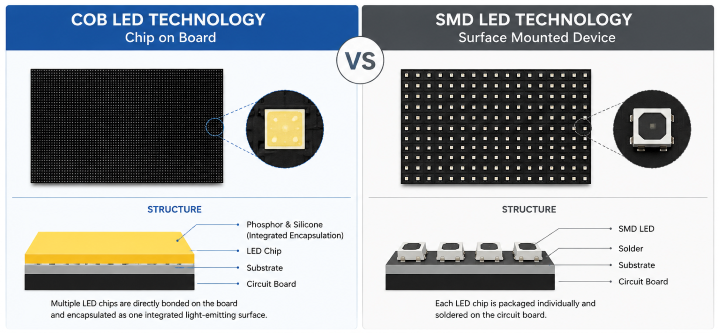
COB vs SMD: Manufacturing Process
Although both COB and SMD LED displays use similar basic components, their manufacturing processes are fundamentally different. This difference affects not only how the LED modules are produced, but also their quality control, maintenance requirements, production complexity, and overall project cost.
SMD Manufacturing Process: LED Chip Packaging → Component Testing → SMT Placement → Reflow Soldering → Module Testing
In SMD production, RGB LED chips are first packaged into individual LED components. These packaged components are then tested before being placed onto the PCB through an automated SMT process. After placement, the PCB passes through a reflow oven to solder the components in place, followed by module testing and calibration.
This process is highly automated and well established, which makes SMD suitable for large-scale production. However, each LED is an individual packaged component, creating more solder joints and exposed components on the module surface.
COB Manufacturing Process: Die Placement → Wire Bonding → Encapsulation → Testing & Calibration
With COB, bare LED dies are mounted directly onto the PCB rather than being individually packaged first. The dies are electrically connected through wire bonding and then covered with a continuous encapsulation layer. The finished module is subsequently tested and calibrated.
Because the LED dies are integrated directly onto the PCB and protected by an encapsulation layer, COB eliminates the separate LED package and reduces the number of exposed components and solder connections on the display surface.
COB vs SMD LED Display: Key Differences
The manufacturing differences described above lead to practical differences in everyday use. The table below brings the main considerations together so you can evaluate COB and SMD not only by image quality, but also by durability, maintenance, thermal performance, cost, and the type of environment in which the display will operate.
|
Comparison Dimension
|
COB LED (Chip-on-Board)
|
SMD LED (Surface-Mounted Device)
|
|
Reliability & Durability
|
Integrated chip structure with protective encapsulation provides stronger resistance against impact and environmental stress.
|
Mature and reliable technology, but exposed LED packages are more vulnerable to physical damage.
|
|
Surface Protection
|
Encapsulated surface offers better protection against dust, moisture, scratches, and accidental contact.
|
Individual LED packages provide basic protection but require more careful handling.
|
|
Fine Pixel Pitch Capability
|
Better suited for micro-pitch displays such as P0.9 and below due to higher integration density.
|
Widely used for standard pixel pitches but becomes more challenging at ultra-fine pitches.
|
|
Image Quality
|
Provides smoother surface appearance, better black uniformity, higher contrast, and improved close-viewing experience.
|
Offers mature color performance and brightness consistency with proven technology.
|
|
Maintenance & Repair
|
Usually supports front maintenance, but repair requires specialized processes.
|
Individual components are easier to replace with mature repair methods.
|
|
Thermal Performance & Power Consumption
|
Direct chip integration improves heat transfer efficiency depending on product design.
|
Additional packaging layers create a longer thermal path.
|
|
Initial Cost
|
Higher initial investment due to advanced manufacturing requirements.
|
Lower cost due to mature manufacturing processes and supply chain advantages.
|
|
Best Application Scenarios
|
Control rooms, conference rooms, broadcast studios, premium commercial displays, fine-pitch LED video walls.
|
Advertising displays, rental LED screens, commercial displays, outdoor LED screens.
|
COB vs SMD: Quick Selection Guide Based on Project Priorities
A technical comparison helps explain the differences between COB and SMD technology, but the final decision should always be based on your project priorities.
Different applications require different performance considerations. For example, control rooms or high-end conference spaces may place greater emphasis on image quality, reliability, and long-term stability, whereas commercial advertising screens may focus more on initial investment and maintenance convenience.
Use the guide below to quickly identify which LED technology better matches your project requirements.
|
If Your Priority Is...
|
Recommended Choice
|
|
Premium image quality
|
COB
|
|
Viewing distance (< 3–5 m)
|
COB
|
|
High-traffic public area
|
COB
|
|
Maximum durability and surface protection
|
COB
|
|
Premium indoor visual experience
|
COB
|
|
Lowest downtime for critical operations
|
COB
|
|
Lower initial investment
|
SMD
|
|
Easier maintenance and lower replacement cost
|
SMD
|
|
Rental or frequently transported LED screens
|
SMD
|
|
Large commercial LED displays with balanced cost and performance
|
SMD
|
Premteco offers leading COB and SMD LED Display Solutions
SP1 PRO Series
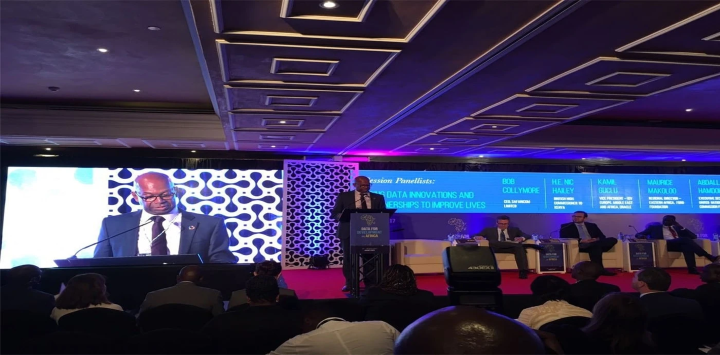
Note: Premteco SP1 PRO P1.5 LED Display in South Africa
Key parameters:
|
Packaging Technology
|
SMD (Surface-Mounted Device)
|
|
Pixel Pitches
|
P0.93, P1.25, P1.56, P1.875
|
|
Brightness
|
350 nits, 400 nits, 500 nits, 800 nits
|
|
Refresh Rate
|
1920 ~ 3840Hz
|
|
Cabinet Size
|
600 × 337.5 × 30 mm
|
|
Cabinet Weight
|
3.8 kg/panel
|
Why Choose SP1 PRO?
High-Quality Black LEDs – Delivers deeper blacks, higher contrast, and improved color uniformity for a refined visual experience.
Fine-Pitch 4K Performance – P0.9–P1.875 options provide high pixel density and sharp, detailed images for close-viewing applications.
Seamless 16:9 Design – Enables gap-free screen connections and standard 16:9 configurations for 2K, 4K, and 8K content.
Ultra-Thin & Reliable Design – Combines a slim, flat cabinet with power and signal redundancy for seamless installation and stable operation.
COBFLEX Series
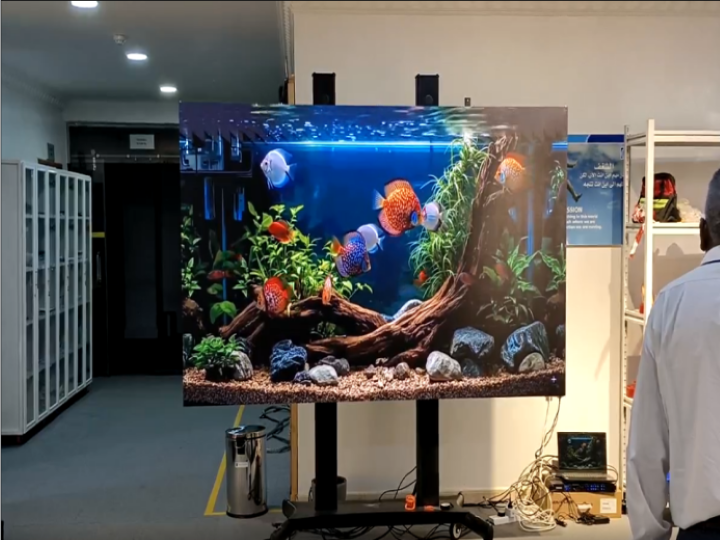
Note: Premteco COBFLEX P1.2 LED Display in Al Jubayl
Key parameters:
|
Packaging Technology
|
COB LED (Chip-on-Board)
|
|
Pixel Pitches
|
P0.9, P1.25, P1.56
|
|
Brightness
|
1200 nits
|
|
Refresh Rate
|
3840Hz~7680Hz
|
|
Cabinet Size
|
600 × 337.5 × 35 mm
|
|
Cabinet Weight
|
4.6 kg/panel
|
Why Choose COBFLEX?
Flexible COB Technology – Combines COB durability with a flexible structure for curved and creative LED installations.
Fine-Pitch Visuals – P0.93, P1.25, and P1.56 deliver sharp, detailed images for close-viewing applications.
Highly Integrated Design – Integrates key components to simplify installation, reduce connections, and improve system reliability.
Premium Visual Performance – Up to 7680Hz refresh rate, 22-bit grayscale, 10,000:1 contrast, and a 160°+ viewing angle ensure smooth, detailed images from a wide range of viewing positions.
FAQ About COB and SMD LED Display
Q1. If two displays meet the required pixel pitch, what should I compare next?
A1: Look beyond pixel pitch. Compare viewing distance, brightness, surface protection, refresh rate, grayscale, maintenance method, cabinet weight, power consumption, operating environment, and total project cost. Pixel pitch determines one important part of the visual experience, but it does not determine the overall suitability of the display.
Q2. Does an encapsulated COB surface make a difference in a high-traffic public area?
A2: It can. The encapsulated COB structure provides stronger surface protection against accidental contact and physical impact than exposed individual SMD packages. That makes COB attractive for displays installed where people may frequently approach, touch, or pass close to the screen.
Q3. If the LED wall can only be serviced from the front, does SMD become a better option?
A3: Not automatically. Both technology types can be designed for front maintenance. The practical question is how easily technicians can access and replace the relevant components. For example, Premteco's SP3 MAX uses a front-access service design, while COB solutions may require more specialized repair procedures because of their integrated structure.
Q4. When does a high-brightness COB display make sense indoors?
A4: High brightness becomes relevant when indoor ambient light is unusually strong or when the application calls for a more demanding HDR-oriented visual experience. Premteco's COB MAX is designed for this type of requirement, with a published brightness range of 1500–3000 nits and applications including TV studios, shopping malls, airports and cinemas.
Q5. For a rental LED screen that is frequently transported and installed, is SMD still the practical choice?
A5: SMD can be a practical choice when frequent installation, dismantling, transportation, and straightforward maintenance are key considerations. Premteco's SP3 MAX is specifically positioned for both fixed-installation and rental/event applications and uses a lightweight 32mm die-cast aluminum cabinet.
Conclusion
COB and SMD LED technologies each have their own advantages. COB is better suited for fine-pitch, premium indoor applications where durability and visual performance are priorities. SMD remains the preferred choice for cost-effective projects requiring mature technology, flexible specifications, and easy maintenance.
If you are evaluating the advantages and disadvantages of COB and SMD technologies for your upcoming project, Premteco's expert team can comprehensively consider your viewing distance, pixel pitch, installation environment, application requirements, and budget to tailor the most cost-effective display solution for you.
→ Get Your Personalized COB or SMD Solution




